
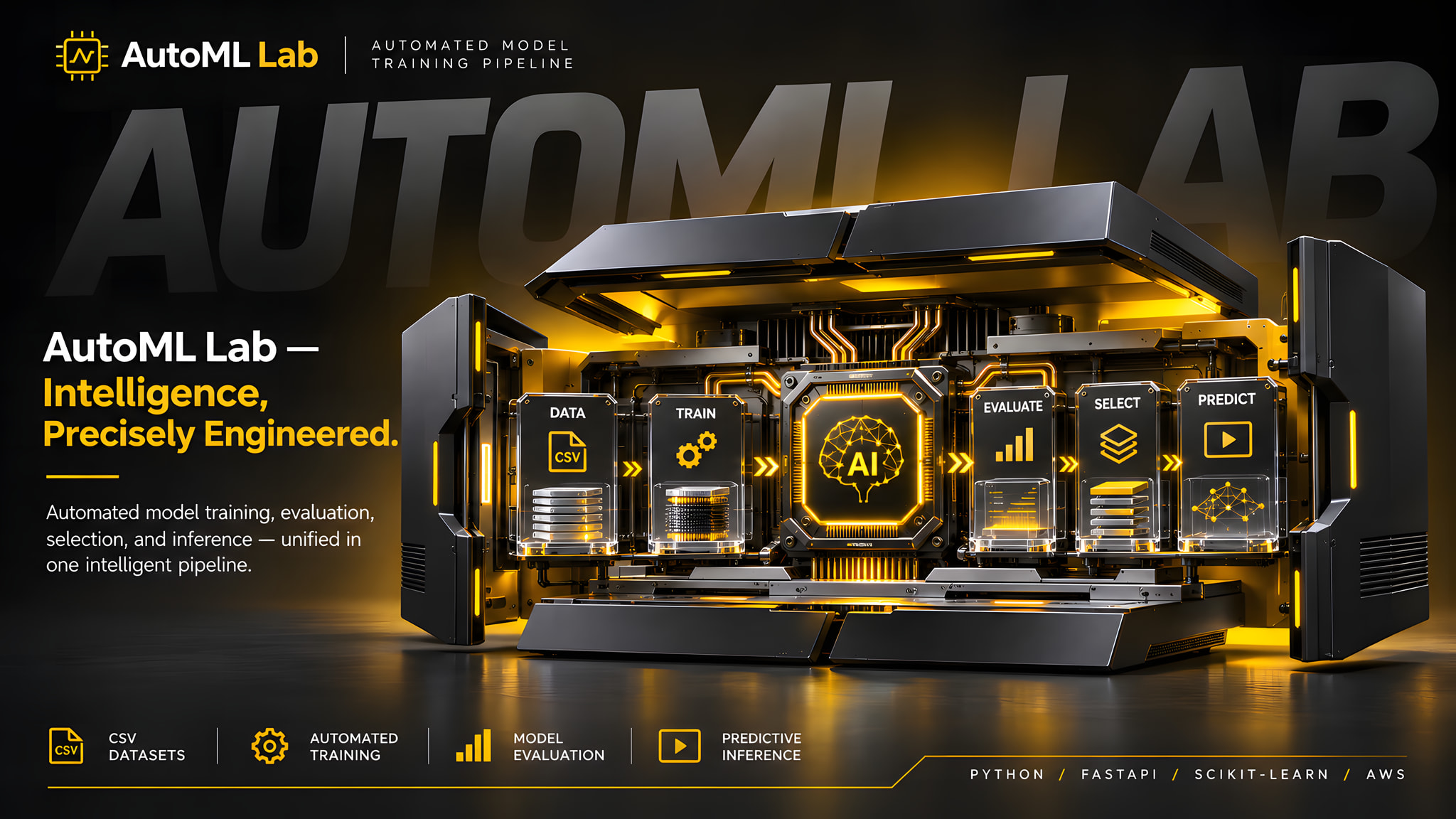
001
Product brief
The project is structured as a full-stack automated machine learning platform utilizing a Next.js frontend and a Python FastAPI backend. It leverages scikit-learn for handling machine learning tasks and integrates with AWS services for scalable cloud execution. The repository includes comprehensive testing suites, Docker configurations, and infrastructure as code via Terraform.
The primary purpose is to streamline the end-to-end machine learning lifecycle for tabular CSV data by automating training, evaluation, and model selection. It allows users to upload datasets, run experiments asynchronously through job queues, and serve predictions from approved models. Additionally, it offers robust deployment pipelines and infrastructure management through automated scripts and continuous integration.
Data scientists, machine learning engineers, and developers looking for an automated platform to train, evaluate, select, and serve machine learning models derived from tabular CSV datasets.
002
What it does
8 evidenced features
- 01
Automated model training, evaluation, model selection and inference for tabular CSV datasets.
- 02
Video file in the repository: [promo-video/final-with-intro.mp4](promo-video/final-with-intro.mp4)
- 03
Animated title cards: [demo-video/06-intro-outro.html](demo-video/06-intro-outro.html) (download and open in a browser; press 1 to 4 to play a card)
- 04
Click the diagram for the scalable SVG version.
- 05
Frontend Next.js app runs on Vercel with automatic redeployments on push, while AWS Amplify Hosting is defined in Terraform as an option.
- 06
Experiment execution records experiments as QUEUED and places the experiment ID onto an SQS queue with a dead-letter queue.
- 07
Approved models serve predictions directly through the API endpoints.
- 08
Automated deployment via GitHub Actions utilizing IAM roles through OIDC to push images to ECR and roll out the Lambda API and worker.
003
How it works
Application Surface and Frontend Boundary
The application surface is initialized through frontend configuration files such as frontend/.dockerignore and frontend/Dockerfile, alongside backend API entrypoints like backend/app/init.py, backend/app/api/init.py, backend/app/api/deps.py, and backend/app/api/health.py. This structural boundary establishes how the Next.js interface and FastAPI server organize their initial routes, dependencies, and health checks.
Domain and Data Management
Domain logic and data handling are centralized across backend/app/api/v1/auth.py, backend/app/api/v1/datasets.py, and related API modules which coordinate with SQLAlchemy models and Alembic database migrations. This setup handles core entity management, dataset ingestion pathways, and authentication rules within the application core.
Delivery, Quality, and Infrastructure Pipelines
Delivery workflows and quality checks are governed by continuous integration files like .github/workflows/ci.yml and .github/workflows/deploy.yml, alongside backend execution scripts like backend/docker/entrypoint.sh. Infrastructure provisioning and deployment tests are supported by files in infrastructure/terraform/ and test modules such as backend/tests/testterraform.py to ensure automated rollouts.
004
Challenge
Managing the end-to-end lifecycle of machine learning models for tabular CSV data often involves repetitive manual intervention across data preprocessing, model training, evaluation, and inference deployment. Building a scalable system requires coordinating asynchronous job queues, cloud storage, secure API endpoints, and infrastructure provisioning without manual overhead. Without an automated pipeline, tracking experiments and deploying approved models efficiently remains a significant bottleneck for engineering teams.
005
Implementation
The platform addresses these challenges by implementing an integrated architecture combining a Next.js frontend with a FastAPI Python backend designed for tabular CSV processing. Experiments are queued asynchronously using message queues with dead-letter handling, while database migrations and data integrity are managed via SQLAlchemy and Alembic. Furthermore, infrastructure is provisioned through Terraform and deployments are automated using GitHub Actions with OIDC authentication to push container images to Amazon ECR and deploy serverless components.
006
Technology stack
Cloud
 AWS SDK
DevOps
 Docker
 GitHub Actions
 Terraform
Backend
 Python
 FastAPI
- Go
Database
- Alembic
 Supabase
 SQLAlchemy
Frontend
 JavaScript/TypeScript
Languages
- Go
007
Repositories
Verified source links for this project.
