
001
System brief
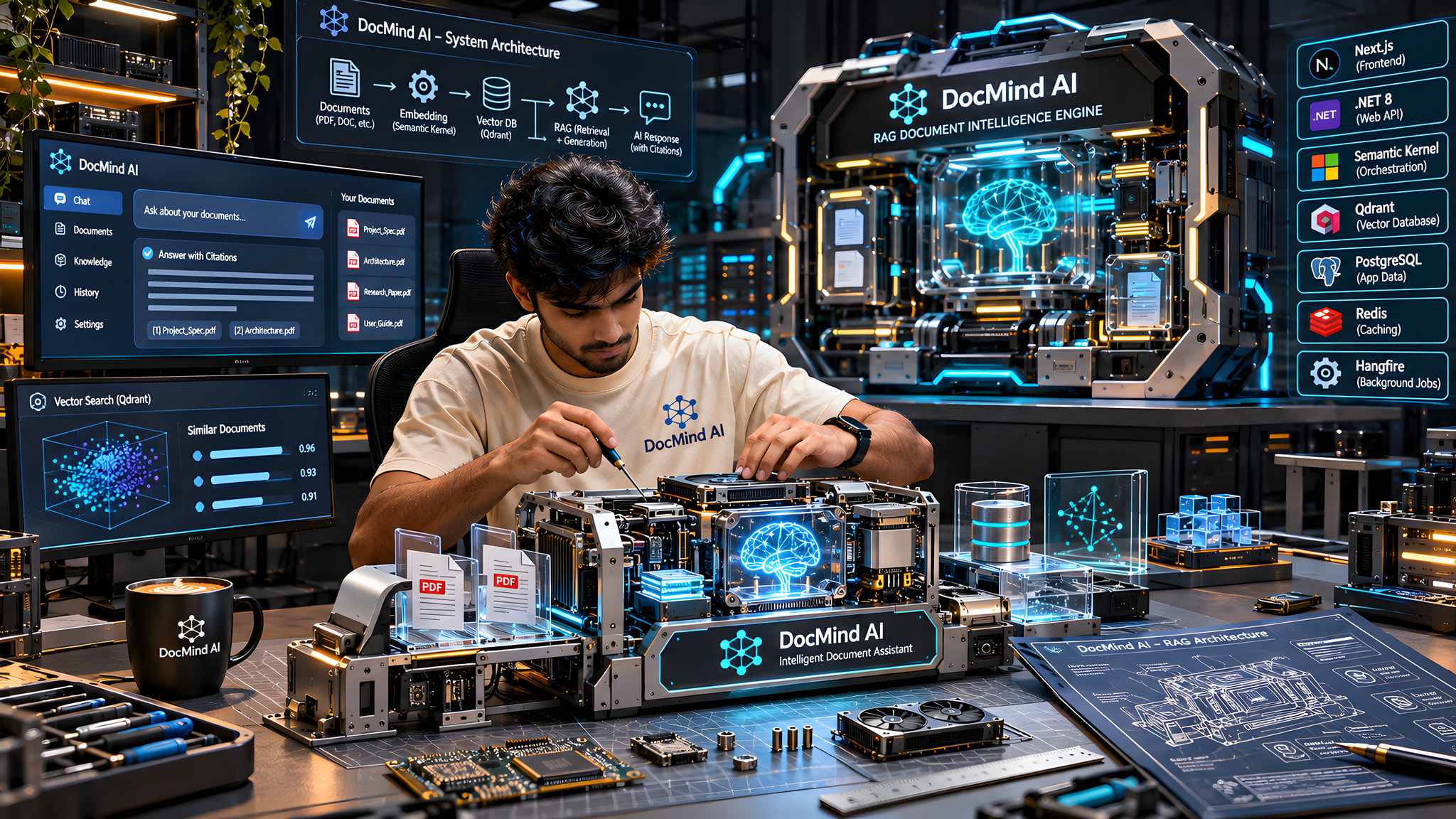
DocMind AI functions as an integrated meta-repository managing multiple submodules and local development infrastructure to support a comprehensive document assistant ecosystem. The system coordinates communication between a React and Next.js client and a .NET 8 Web API backend. By leveraging specialized services like Semantic Kernel, Qdrant, PostgreSQL, Redis, and Hangfire, it ensures streamlined processing and retrieval of document intelligence.
The primary purpose of the project is to provide a seamless retrieval-augmented generation document assistant that processes user questions through embeddings and similarity searches. It handles prompt assembly, streamed LLM completions, and generates answers complete with citations. Furthermore, all conversation history is reliably persisted to maintain context across sessions.
The application serves users seeking an intelligent document assistant capable of processing complex queries against internal data stores. It accommodates developers and end-users interacting with a modern frontend client connected to a high-performance backend API. The architecture supports robust authentication, document management, and interactive chat functionalities.
002
What it does
8 evidenced features
- 01
This is the meta-repository. It ties together two independent projects as git submodules and provides the local development infrastructure shared by both:
- 02
Full architecture spec: [docs/RAG System Architecture.pdf](docs/RAG%20System%20Architecture.pdf).
- 03
React/Next.js client
- 04
│ REST + SignalR
- 05
.NET 8 Web API ──► Auth / Documents / Chat services
- 06
Semantic Kernel ──► OpenAI (chat + embeddings)
- 07
Qdrant (vector search) + PostgreSQL (relational data) + Redis (cache) + Hangfire (background jobs)
- 08
Chat flow: question → embed → Qdrant similarity search (top 5) → prompt assembly → streamed LLM completion → answer + citations, persisted to conversation history.
003
Architecture deep dive
Meta-Repository and Local Development Infrastructure
The project uses docker-compose.yml and .gitmodules to tie together independent backend and frontend submodules. These configuration files establish the local development infrastructure and ensure both components synchronize correctly within the Main-DocMind-AI repository.
Backend and Frontend Submodule Boundaries
The backend boundary is housed in the backend-DocMind AI submodule at commit 504e203ef1faf3464709990905154a7f828f6b55, while the frontend boundary is housed in the frontend-DocMind AI submodule at commit e05ad897107dae58f440a5c26911b6118e9f252a. These submodules separate the .NET 8 Web API services from the Next.js and React client application.
Continuous Integration and Workflow Delivery
Delivery and quality are managed through GitHub Actions workflows such as .github/workflows/notify-resume.yml, alongside submodule-specific workflows like backend-DocMind AI/.github/workflows/ci.yml and frontend-DocMind AI/.github/workflows/release.yml. These automation scripts handle project build checks and release cycles across the repository.
004
Challenge
Modern document retrieval systems often struggle to combine relational user management, background job processing, and vector similarity search into a unified architecture. Managing separate frontend and backend repositories without a coordinated local development setup leads to friction during deployment and integration. Additionally, users require precise context retrieval, accurate citations, and persistent conversation history when querying large collections of documentation.
005
Implementation
The project resolves these challenges by constructing a meta-repository that integrates a .NET 8 Web API backend and a Next.js frontend client via git submodules. It implements a structured chat flow where user questions are embedded, evaluated using Qdrant vector similarity search for the top 5 results, assembled into prompts, and sent to OpenAI via Semantic Kernel for streamed completions. The architecture also incorporates PostgreSQL for relational data, Redis for caching, Hangfire for background jobs, and Docker for local infrastructure orchestration.
006
Technology stack
DevOps
 GitHub Actions
 Docker
Frontend
 JavaScript/TypeScript
 Next.js
 React
- TypeScript
 Tailwind CSS
007
Repositories
Verified source links for this project.
